
Faith rightly placed is a great saviour, but housed in perverted heads it brings about hatred, destruction and mayhem. When we hate others under the canopy of religion, race, gender, caste, creed, we walk a path to hell. I wonder if woman ever fought wholesale in the name of religion. Mostly they create and nurture life--Give birth, suckle and bring up the babies. This fact was well appreciated by our fore-fathers and fore-mothers in prehistoric periods. The Mother was God for the life could be created only by her. Hinduism being an ancient religion with direct and continuing link with human prehistory has elements from the ancient world and belief that God is feminine. .
As I travelled in search of the art and wisdom of India in its temples and customs strewn across the country, I found exquisite gems of a philosophy and art that can not be appreciated unless one surrenders the blinkers and regimented toxicity of thought and attitude towards the celebration the feminine in
Hinduism. I tried to work out the proportion of female figures on temple walls I found they outnumber male images in some cases by 80%!!
If one knows about the original Khasi inhabitants of Meghalaya, one would be familiar with the matriarchal society that flourishes there.
A goddess in reclining birth giving posture found on many temples is called Lajja Gauri. I saw a 5th century example of it in Badami in Karnataka. The Face is generally covered in a round flower shape and her legs drawn up in the birth giving posture. The caves of Badami are famous for excellent art of Badami Chalukyas and painted caves with images from Hinduism and Jainism from 4-5th century. The dancing Shiva in the first cave is a sublime example of the spiritual art of India. The graceful dance postures is what in all probability encouraged the development of Nataraja image of Shiva. Below the caves as you enter the precincts there is ASI Museum that has this beautiful Lajja Gauri sculpture. there are other very good examples of Indian art and its spiritual reach.
Women held in high esteem nurtured a religion with very little violence and hatred and war-mongering destruction. Hinduism, Jainism and Buddhism are as such the religions of peace.
Ranakpur Jain temple Rajasthan sculpture of dancing goddess

In my book Mona Lisa does not smile anymore I have used the images of goddesses that stood for God as a feminine Eternal.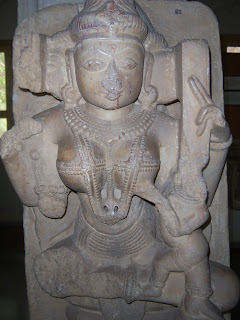
As I travelled in search of the art and wisdom of India in its temples and customs strewn across the country, I found exquisite gems of a philosophy and art that can not be appreciated unless one surrenders the blinkers and regimented toxicity of thought and attitude towards the celebration the feminine in
Hinduism. I tried to work out the proportion of female figures on temple walls I found they outnumber male images in some cases by 80%!!
If one knows about the original Khasi inhabitants of Meghalaya, one would be familiar with the matriarchal society that flourishes there.
A goddess in reclining birth giving posture found on many temples is called Lajja Gauri. I saw a 5th century example of it in Badami in Karnataka. The Face is generally covered in a round flower shape and her legs drawn up in the birth giving posture. The caves of Badami are famous for excellent art of Badami Chalukyas and painted caves with images from Hinduism and Jainism from 4-5th century. The dancing Shiva in the first cave is a sublime example of the spiritual art of India. The graceful dance postures is what in all probability encouraged the development of Nataraja image of Shiva. Below the caves as you enter the precincts there is ASI Museum that has this beautiful Lajja Gauri sculpture. there are other very good examples of Indian art and its spiritual reach.
Women held in high esteem nurtured a religion with very little violence and hatred and war-mongering destruction. Hinduism, Jainism and Buddhism are as such the religions of peace.
Ranakpur Jain temple Rajasthan sculpture of dancing goddess

In my book Mona Lisa does not smile anymore I have used the images of goddesses that stood for God as a feminine Eternal.


